
Mezcal & the World of Agave Spirits
Tequila is one member of a much larger family. Mezcal and the broader world of agave spirits encompass dozens of varieties, regions, and traditions — a universe of flavor rooted in a single remarkable plant.
What Mezcal Is
Mezcal is a distilled spirit made from the cooked piñas of agave plants. Where tequila is restricted to a single agave variety and a defined region, mezcal is far broader: it can be made from many different agave species, often wild-harvested, and it is produced across several Mexican states. The result is a category of extraordinary range — from clean, mineral espadín mezcals to wildly complex bottles blended from rare wild agaves.
Mezcal is often associated with smoke, and many traditional mezcals do carry a distinctive smoky character. This comes from the way the agave is cooked: in earthen pits lined with hot stones and wood, which infuses the piñas with smoke before fermentation and distillation.
How Mezcal Differs From Tequila
All tequila is technically a mezcal, but not all mezcal is tequila. The two differ in three main ways. First, the agave: tequila must be made from blue Weber agave, while mezcal can be made from dozens of varieties. Second, the region: tequila is limited to five states, while mezcal is produced across several, with Oaxaca as its heartland. Third, the method: tequila is typically cooked in brick ovens or autoclaves, while mezcal is often roasted in earthen pits, which gives it its signature smoke.
Read the full comparison in Tequila vs Mezcal.
Different Agave Varieties
There are dozens of agave species used to make mezcal, and each brings its own character. Espadín is the most common — approachable, versatile, and the backbone of most mezcal on the market. Tobalá, tepeztate, madrecuixe, and arroqueño are among the prized wild or semi-cultivated varieties, each offering distinct floral, herbal, or mineral notes and often a longer maturation. A single bottle may be made from one variety or blended from several.
Tequila, by contrast, relies on one: blue Weber agave.
Traditional Production
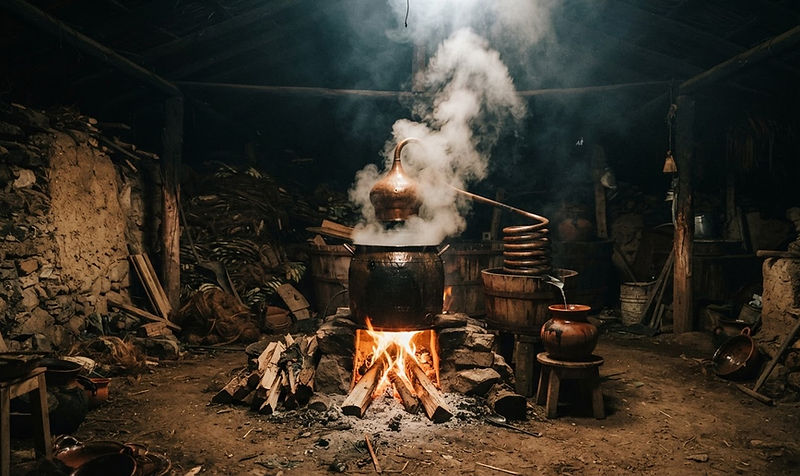
Traditional mezcal is made by hand in small palenques. The mature agave is harvested, the piñas are roasted in earthen pits over hot stones and wood, then crushed — often by a stone tahona wheel drawn by a horse or mule, or by hand with a mallet. The crushed fiber and juice are fermented together in open vats, then distilled, typically in copper or clay stills. Many producers distill with the agave fibers included, which contributes to mezcal's texture and complexity.
This is a slower, more labor-intensive process than most modern tequila production, and it is a large part of why mezcal carries such a strong sense of place. See the tequila equivalent in How Tequila Is Made.
Major Producing Regions
Mezcal's denomination of origin covers several states, with Oaxaca producing the vast majority. Durango, Guerrero, San Luis Potosí, Zacatecas, and parts of Guanajuato and Michoacán are also recognized. Each region contributes its own agaves, traditions, and microclimates, so a mezcal from Oaxaca can taste quite different from one made in Durango — even when both are made from espadín.
For tequila's geography, see Where Is Tequila Made?
Other Agave Spirits
Beyond tequila and mezcal, Mexico produces a range of other agave spirits, many with their own denominations and traditions. Bacanora comes from Sonora. Sotol, while technically made from a different plant (dasylirion), is often grouped with agave spirits and comes from Chihuahua, Coahuila, and Durango. Raicilla is a traditional spirit from Jalisco and Nayarit. Comiteco, tuxca, and other regional distillates round out a landscape that is far richer than the two names most drinkers know.
Explore agave cocktails or read our history of tequila.